Kai Werner · 26 October 2026
Strategies for Minimizing Latency in Real-Time Note Updates for Remote Collaboration Platforms
Real-time note updates in remote collaboration platforms rely on fast data synchronization across distributed users, and latency arises when network delays, processing bottlenecks, or inefficient conflict resolution slow down these exchanges. Observers note that teams working on shared documents experience interruptions when updates fail to propagate instantly, which disrupts workflows in fields ranging from software development to academic research. Data from industry reports indicate that average round-trip times exceeding 100 milliseconds often lead to visible lags in cursor positions and text insertions.
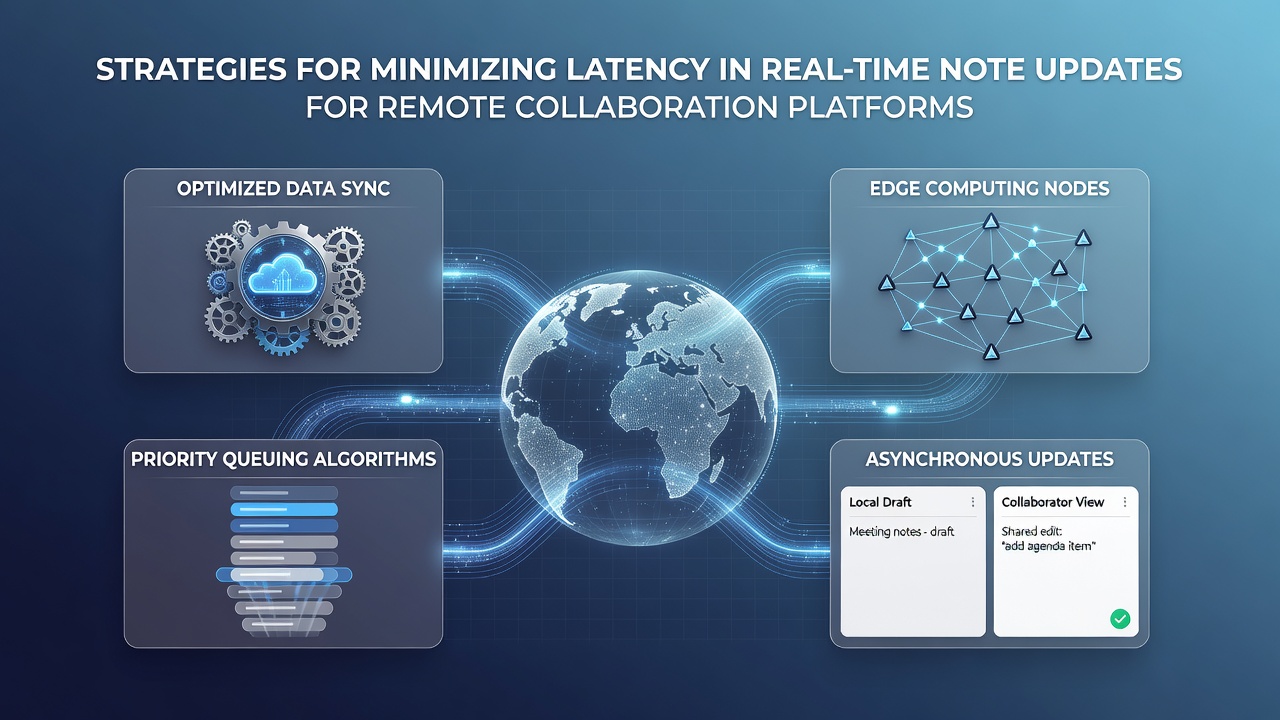
Engineers address these issues through a combination of protocol choices, algorithmic improvements, and infrastructure adjustments. WebSocket connections replace traditional HTTP polling in many systems because they maintain persistent channels that allow servers to push changes immediately rather than waiting for client requests. Studies from research institutions show this shift cuts unnecessary overhead and keeps transmission delays low during active editing sessions.
Protocol Selection and Connection Management
Choosing the right communication protocol forms the foundation for low-latency performance. Platforms implement WebSockets alongside fallback mechanisms such as Server-Sent Events to handle varying network conditions. Researchers discovered that multiplexing multiple update streams over a single connection reduces the number of handshakes required, which proves especially useful when hundreds of users edit simultaneously. Connection pooling further stabilizes performance by reusing established links instead of opening new ones for each note change.
Compression techniques complement these protocols. Delta encoding sends only the differences between versions rather than full document states, and libraries like those based on Protobuf or MessagePack shrink payload sizes effectively. Figures from academic analyses reveal that such methods lower bandwidth usage by 60 to 80 percent in typical collaborative scenarios, which directly shortens transfer times across long-distance links.
Data Synchronization Algorithms
Conflict resolution algorithms play a central role once updates arrive at the server. Operational Transformation transforms incoming edits so they apply correctly regardless of arrival order, while Conflict-Free Replicated Data Types offer an alternative that avoids central coordination altogether. One study revealed that CRDT implementations handle concurrent insertions and deletions with minimal reconciliation overhead, which keeps note updates feeling instantaneous even when participants work from different continents.
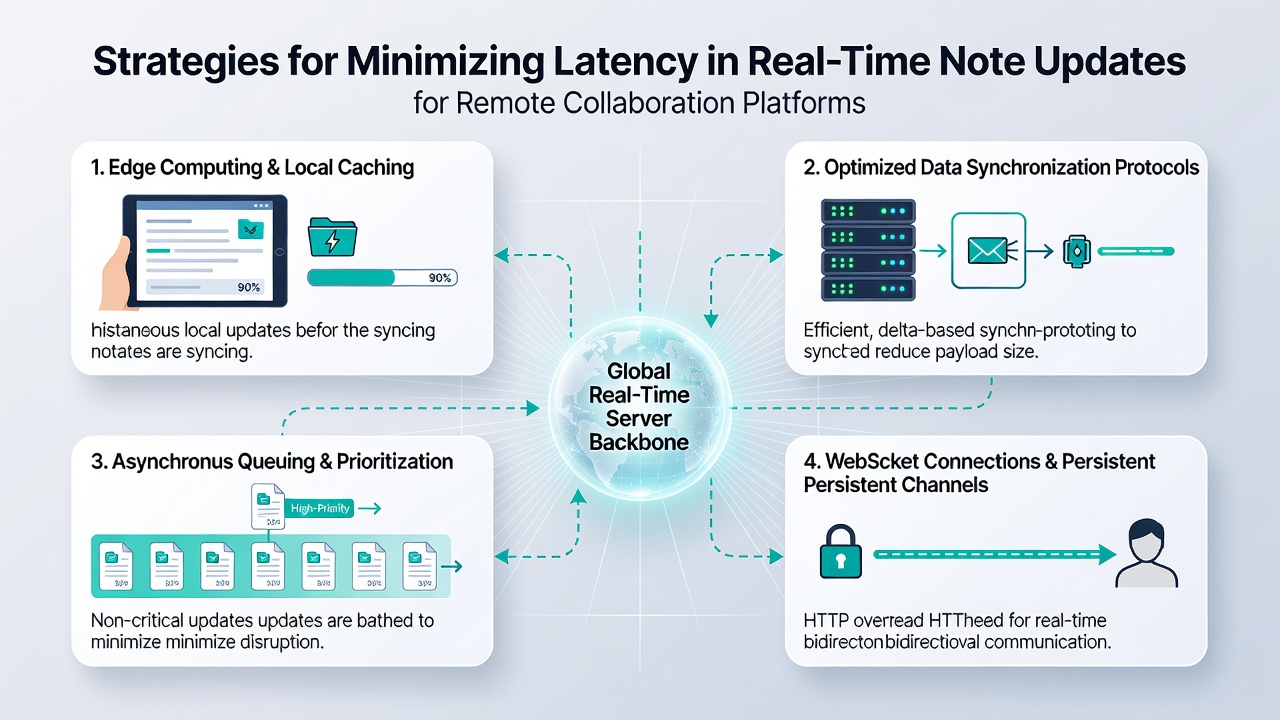
Edge computing extends these benefits by placing processing nodes closer to end users. Content delivery networks cache frequently accessed note segments at regional points of presence, and servers located in October 2026 deployments demonstrated reduced propagation times when regional instances handled local edits before syncing globally. This distributed approach limits the distance data must travel and prevents single-region congestion from affecting all participants.
Infrastructure and Caching Strategies
Caching layers store recent note states in memory systems like Redis, which allows rapid retrieval without repeated database queries. Adaptive caching policies prioritize active documents while expiring stale entries, and this balance prevents memory bloat. Experts have observed that combining in-memory caches with persistent storage creates a tiered system where hot data remains accessible at sub-millisecond speeds.
Monitoring tools track latency metrics in real time, and platforms use these insights to trigger automatic adjustments. When delays exceed thresholds, systems can reroute traffic through less congested paths or increase compression levels dynamically. Reports from government digital infrastructure programs in Canada highlight how such adaptive routing maintains consistent performance during peak usage periods across national networks.
Client-Side Optimizations
Client applications contribute to latency reduction through efficient rendering pipelines. Batching small updates into larger transmissions avoids flooding the network with tiny packets, and virtual DOM techniques update only changed portions of the interface. Developers integrate predictive algorithms that anticipate likely edits based on user patterns, which pre-loads related content and masks minor delays.
Security measures integrate without adding significant overhead when implemented correctly. End-to-end encryption occurs at the client before transmission, and hardware acceleration on modern devices handles cryptographic operations quickly. Data from EU technical assessments indicate that optimized encryption libraries introduce negligible added latency when paired with efficient key management.
Conclusion
Effective latency minimization in real-time note updates requires coordinated application of protocols, algorithms, and infrastructure choices. Platforms that combine WebSocket persistence, CRDT-based synchronization, edge distribution, and adaptive caching achieve measurable improvements in update speed across diverse user locations. Continued refinement of these strategies supports seamless remote collaboration as adoption grows.